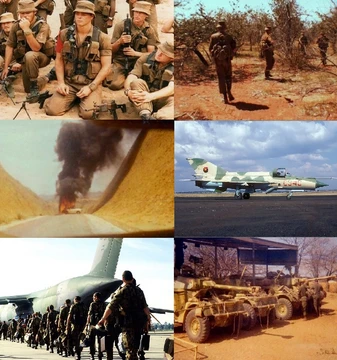
Eritrean War of Independence

The Eritrean War of Independence was an armed conflict and insurgency aimed at achieving self-determination and independence for Eritrea from Ethiopian rule.
- field
- Armed conflict and insurgency
- location
- Eritrea Province, Ethiopian Empire / People's Democratic Republic of Ethiopia
- known_for
- Achieving Eritrean independence from Ethiopia after a thirty-year armed struggle
Lore & Background
In 1962, Emperor Haile Selassie dissolved the federation and annexed Eritrea, triggering widespread support for the insurgency. During the 1960s, the ELF led the struggle, but internal struggles and sectarian violence splintered the organization.
Reader's Guide
The Eritrean War of Independence was a protracted guerrilla conflict that reshaped the Horn of Africa. It began as a low-level insurgency by the ELF, which drew support from Muslim Eritreans and various Arab countries, but struggled to gain Christian backing due to its Islamist orientation. The dissolution of the federation in 1962 and the Ethiopian imperial army's counterinsurgency campaigns, which terrorized civilians, increased local support for independence. The 1974 Ethiopian Revolution brought the Derg to power, a Marxist-Leninist regime backed by the Soviet Union, which intensified the conflict. The EPLF, under leaders like Isaias Afwerki, eventually became the dominant force, exploiting the Ogaden War and the decline of the Mengistu regime. The war's legacy includes the establishment of an independent Eritrea and the demonstration of how guerrilla warfare, combined with internal and external political shifts, can achieve self-determination.
Did You Know?
- The federation between Eritrea and Ethiopia was dissolved by Emperor Haile Selassie in 1962, leading to Eritrea's formal annexation.
Categorization Among Independence Conflicts
The Eritrean War of Independence is one entry within the broader family of armed conflicts fought for the independence of a nation. In the classification system used to catalog such struggles, it is identified as a case where independence succeeded, which distinguishes it sharply from conflicts that ended in failure, stalemate, or continued fighting. It also sets it apart from situations where only de facto independence with limited recognition was achieved, or where autonomy was granted as a compromise, or where the conflict remains ongoing without resolution. The Eritrean conflict occupies the contemporary period, spanning from 1945 to the present, placing it among the most recent wave of nations that have pursued and ultimately secured political independence through armed struggle rather than diplomatic concession.
The Spectrum of Independence Outcomes
Not every armed conflict fought for national independence reaches the same conclusion. The Eritrean struggle, which achieved its goal of political independence, represents one endpoint on a spectrum that also includes independence that failed entirely, de facto independence with limited international recognition, the granting of autonomy as a partial concession, stalemate where neither side prevails, and ongoing conflict with no definitive resolution. This range of possible outcomes underscores that the path from armed resistance to sovereign statehood is far from guaranteed. The Eritrean case, as one where independence succeeded, stands in meaningful contrast to the numerous other conflicts in the same category where the fighting either never resolved into full sovereignty or where the final political status remained ambiguous and contested among the parties involved.
Historical Periodization and Context
The Eritrean War of Independence is situated within the contemporary era of independence conflicts, defined as those occurring from 1945 to the present. This places it in a distinct historical window separate from ancient struggles before 500 AD, medieval conflicts between 500 and 1500, early modern wars from 1500 to 1800, and late modern conflicts from 1800 to 1945. The contemporary period is characterized by a notable proliferation of nations seeking self-determination, and the Eritrean conflict is one thread within that broader tapestry of post-war sovereignty movements. Its classification as a successful independence war in this era highlights how the world after 1945 continued to produce armed struggles for national sovereignty, even as the global political landscape shifted dramatically through decolonization and the reordering of state boundaries.
Connections to Broader Categories of Armed Conflict
The Eritrean War of Independence does not exist in isolation but connects to a wider web of related conflict categories that scholars and cataloguers use to organize political violence. It is linked to the general concept of wars of independence, to resistance movements during World War II, to active separatist movements, to revolutions and rebellions, to broader compilations of wars, and to non-international armed conflicts. These connections illustrate that the Eritrean struggle shares structural and thematic DNA with many other forms of political violence and organized resistance. Whether viewed as a non-international armed conflict, a revolution, or a separatist movement, the Eritrean case intersects with multiple categories of conflict, reflecting the complex and overlapping nature of armed struggles for political self-determination across different historical and geographic contexts.
Frequently Asked Questions
What is the Eritrean War of Independence?
It is a prolonged armed conflict and insurgency in which Eritrean fighters fought against Ethiopian authority to secure their own sovereignty. The struggle is catalogued as entry 1-19 in the African Wars of Independence series.
Where did the Eritrean War of Independence take place?
The fighting was centered in the Eritrea Province, spanning the period of the Ethiopian Empire and later the People's Democratic Republic of Ethiopia.
How long did the Eritrean War of Independence last?
The conflict stretched across roughly thirty years of continuous armed struggle before Eritrea finally won its independence.
What was the primary objective of the Eritrean War of Independence?
The central aim was self-determination: to free Eritrea from Ethiopian rule and establish it as a sovereign, independent nation.
Why is the Eritrean War of Independence considered significant?
It is remembered as one of the longest and most determined independence campaigns in Africa, ultimately succeeding in delivering Eritrean sovereignty after three decades of war.
More in African Wars Of Independence 1-19
Spotted an error? Know more?
This is a living reference — every entry is fact-audited, and reader corrections feed straight into our audit queue. Suggest an edit · See this site's audit record