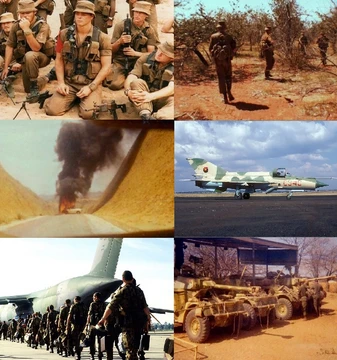
First Congo War
Conflict that overthrew Mobutu and led to the Second Congo War.

The war resulted in the overthrow of Zairean President Mobutu Sese Seko, who was replaced by rebel leader Laurent-Désiré Kabila.
- location
- Zaire (renamed Democratic Republic of the Congo)
- result
- Overthrow of Mobutu Sese Seko; Laurent-Désiré Kabila becomes president
- key_actors
- Rwanda, Uganda, Burundi, Angola, Eritrea, anti-Mobutu Congolese rebels, Sudanese troops (supporting government)
- casualties
- Hundreds of thousands died
Lore & Background
The Zairean government under Mobutu, weakened by years of dictatorship and corruption, was unable to maintain control, and the army had deteriorated significantly. With Mobutu terminally ill and unable to manage his fractured government, loyalty to his regime waned. The end of the Cold War further reduced Mobutu's international support, leaving his regime politically and financially bankrupt. This invasion expanded as Uganda, Burundi, Angola, and Eritrea joined, while an anti-Mobutu coalition of Congolese rebels formed. Despite efforts to resist, Mobutu's regime quickly collapsed, with widespread violence and ethnic killings occurring throughout the conflict. Hundreds of thousands died as the government forces, supported by Sudanese troops, were overwhelmed. After Mobutu's ousting, Kabila's government renamed the country the Democratic Republic of the Congo. However, his regime remained unstable, as he sought to distance himself from his former Rwandan and Ugandan backers. In response, Kabila expelled foreign troops and forged alliances with regional powers such as Angola, Zimbabwe, and Namibia.
Reader's Guide
The First Congo War is significant as a pivotal conflict that ended the long dictatorship of Mobutu Sese Seko in Zaire and brought Laurent-Désiré Kabila to power, renaming the country the Democratic Republic of the Congo. Some historians view the First and Second Congo Wars as part of a continuous conflict with lasting effects that continue to affect the region today. The war also highlighted the collapse of the Zairean state, the role of ethnic tensions, and the international dimensions of African conflicts in the post-Cold War era.
Did You Know?
- The First Congo War is also known as Africa's First World War.
- Zaire was renamed the Democratic Republic of the Congo during the conflict.
- The war resulted in the overthrow of President Mobutu Sese Seko, who was replaced by rebel leader Laurent-Désiré Kabila.
The Unraveling of a Dictatorship
By the mid-1990s, Mobutu Sese Seko's grip on Zaire had deteriorated into something resembling a hollow shell. The country's GDP had plummeted by roughly 65 percent between independence in 1960 and the end of his rule in 1997, and most citizens survived through an informal economy because the official one had become unreliable. The national army, the Forces Armées Zaïroises, had degenerated to the point of preying on its own population for survival—Mobutu himself reportedly questioned why soldiers needed pay when they already possessed weapons. After the Cold War ended in 1992, the United States withdrew its backing in favor of what it termed a 'new generation of African leaders,' including Rwanda's Paul Kagame and Uganda's Yoweri Museveni. Faced with a continent-wide wave of democratization, Mobutu formally dismantled his one-party system but refused to pursue genuine reform, alienating domestic and foreign allies alike. Terminally ill and unable to manage his fractured government, he watched loyalty to his regime evaporate while rebel groups found sanctuary in the vast eastern provinces far from Kinshasa.
Centuries of Ethnic Fracture in the East
The violence that erupted in eastern Zaire in 1996 was rooted in tensions stretching back centuries, particularly between the agrarian communities of the Congo and the Banyarwanda populations of Kivu province. Colonial-era border drawing in the late nineteenth century left many Banyarwanda on the Congolese side of the line. Waves of migration followed: pre-colonial arrivals in the 1880s, Belgians who forcibly relocated laborers after 1908, and a later surge of emigrants fleeing the 1959 social revolution that brought the Hutu to power in Kigali. Tutsi who arrived before 1960 independence were designated Banyamulenge and held citizenship rights, while those arriving afterward were labeled Banyarwanda, though local populations often treated both groups as foreigners. Mobutu deliberately empowered the Banyamulenge in the east, hoping this minority would suppress opposition from more numerous ethnicities—a strategy that intensified existing grievances. The 1963–1966 Kanyarwanda War saw Hunde and Nande communities clash violently with Rwandan emigrants in multiple massacres. A 1981 citizenship law stripped political rights from both groups, and between 1993 and 1996, recurring attacks by Hunde, Nande, and Nyanga youth against Banyamulenge communities claimed an estimated 14,000 lives.
A Multi-National Storm and Rapid Collapse
What began as a targeted Rwandan incursion into eastern Zaire in 1996—aimed at rebel groups that had taken shelter there—quickly snowballed into a broader regional conflict. Uganda, Burundi, Angola, and Eritrea joined the offensive, while a coalition of anti-Mobutu Congolese rebels, including Laurent-Désiré Kabila, an ethnic Luba from Katanga who had opposed the regime since its inception, mounted a parallel internal challenge. The Zairean government, propped up by Sudanese troops, proved unable to mount an effective defense. The army's structural decay, the government's financial bankruptcy, and the waning loyalty of its own officials meant the regime crumbled with startling speed. Widespread violence and ethnic killings swept through the conflict zone, and hundreds of thousands of lives were lost as government forces were overwhelmed. The war, which ran from 24 October 1996 to 16 May 1997, ended with Mobutu's overthrow and Kabila's assumption of power, fundamentally reshaping the political landscape of a nation that had been in freefall for decades.
Seeds of the Next War
Kabila's victory brought a new name to the country—the Democratic Republic of the Congo—but it did not bring stability. Almost immediately, he moved to assert independence from the Rwandan and Ugandan forces that had been instrumental in his rise. He expelled those foreign troops from Congolese soil and forged new alliances with regional powers including Angola, Zimbabwe, and Namibia. These decisive moves were read in Kigali and Kampala as a betrayal, and the response was swift: a second invasion by Rwanda and Uganda in 1998 ignited the Second Congo War, which would rage until 2003. The First Congo War, therefore, cannot be understood in isolation. The destabilizing aftermath of the 1994 Rwandan genocide, the influx of refugees and militant groups into Zaire, the ethnic fractures in the east, and the collapse of state authority all created conditions in which one war bled directly into the next. Many historians and analysts now treat the two conflicts as a single, continuous episode whose reverberations continue to shape the region's politics, security, and humanitarian landscape to this day.
Frequently Asked Questions
What was the First Congo War?
The First Congo War (1996–1997) was a regional armed conflict fought on the territory of Zaire (now the Democratic Republic of the Congo) in which a coalition of rebel forces, backed by several neighboring states, marched on the capital and toppled the long-standing government.
Who overthrew Mobutu Sese Seko and who replaced him?
Rebel leader Laurent-Désiré Kabila, supported by troops from Rwanda, Uganda, and Burundi, led the offensive that forced Mobutu to flee the country in May 1997. Kabila then assumed the presidency of the renamed Democratic Republic of the Congo.
Which countries were directly involved in the fighting?
The main belligerents included anti-Mobutu Congolese rebels backed by Rwanda, Uganda, Burundi, Angola, and Eritrea, while the Zairean government side received military support from Sudanese forces.
How many people died in the First Congo War?
Estimates place the death toll in the hundreds of thousands, making it one of the deadliest conflicts in the Great Lakes region of the 1990s.
How did the First Congo War lead into the Second Congo War?
Kabila's new government soon turned against its former Rwandan and Ugandan backers, triggering a much broader regional conflict in 1998 that is now recognized as the Second Congo War.
More in African Wars Of Independence 1-19
Spotted an error? Know more?
This is a living reference — every entry is fact-audited, and reader corrections feed straight into our audit queue. Suggest an edit · See this site's audit record