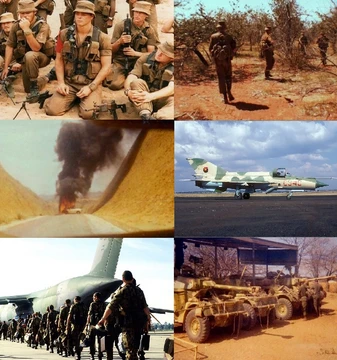
Guinea-Bissau War of Independence
Armed conflict for Guinea-Bissau's independence from Portugal.

The Guinea-Bissau War of Independence (1963–1974), also known as the Bissau-Guinean War of Independence, was an armed conflict between Portugal and the African Party for the Independence of Guinea and Cape Verde (PAIGC). It is often called 'Portugal's Vietnam' due to its protracted guerrilla nature, high costs, and the internal political turmoil it caused in Portugal. The war ended with PAIGC achieving independence through armed struggle, making it one of the first sub-Saharan African liberation movements to do so—unlike Kenya's Mau Mau uprising, which was primarily a Kikuyu revolt and whose independence was ultimately negotiated, not won solely by armed force.
- start_year
- 1963
- end_year
- 1974
- location
- Portuguese Guinea
- belligerents
- Portugal vs. PAIGC
- paigc_combat_strength
- estimated at no more than 7,000
- external_support_for_paigc
- Soviet Union, China, Cuba, Algeria, Guinea, Libya, Czechoslovakia, Senegal
Lore & Background
PAIGC reorganized in exile in Conakry, Guinea, and mobilized rural peasants. By the early 1970s, PAIGC controlled much of the countryside, while Portuguese forces were confined to major cities and fortified bases.
Reader's Guide
The Guinea-Bissau War of Independence is significant as a successful anti-colonial guerrilla war that forced Portugal to grant independence in September 1974, after the Carnation Revolution. PAIGC's victory demonstrated the effectiveness of a well-organized liberation movement with external support from socialist states and neighboring African countries. The war also contributed to political instability in Portugal, leading to the overthrow of the Estado Novo regime. Its legacy includes the establishment of the Republic of Guinea-Bissau and the precedent for other African liberation movements.
Did You Know?
- The war is commonly referred to as 'Portugal's Vietnam' because it was a protracted guerrilla war with high costs in men and material.
- PAIGC was one of the first sub-Saharan African liberation movements to achieve independence through armed struggle; earlier movements, such as Kenya's Mau Mau uprising, were primarily ethnic revolts and their independenc
- The Pidjiguiti massacre in August 1959, in which at least fifty people were killed, led PAIGC to shift from constitutional agitation to armed struggle.
From Street Protests to Rural Insurgency
The African Party for the Independence of Guinea and Cape Verde, established in 1956 by Rafael Barbosa and the nationalist thinker Amílcar Cabral, initially pursued a strategy of legal and constitutional pressure within Portuguese Guinea. During its first three years, the party concentrated its energy in Bissau and other urban centers, sometimes working alongside local trade unions, but these efforts yielded little progress. Everything changed on 3 August 1959, when PAIGC helped organize a major dockworkers' strike at the Port of Bissau. Portuguese authorities responded with brutal force, killing at least fifty people and wounding several hundred in what became known as the Pidjiguiti massacre. That bloodshed marked a decisive turning point. Cabral ordered the party to go underground and redirected its political cadres to Conakry, the capital of neighboring Guinea, where they could plan in safety. Between 1960 and 1963, the movement underwent what observers described as a total transformation. Scores of cadres were trained and dispatched into the Guinean countryside to win over the rural peasantry, while the political leadership pursued a diplomatic offensive that secured the full cooperation of the Guinean government, the tacit backing of Senegal, and contacts with other liberation movements and left-wing parties.
Portugal's Vietnam: A War of Attrition
The conflict that erupted in January 1963 quickly earned the grim nickname "Portugal's Vietnam." It was a protracted guerrilla war that exacted extremely high costs in both human lives and material resources, and it generated significant internal political turmoil within Portugal itself. At the outset of hostilities, the Portuguese garrison consisted of merely two infantry companies concentrated in the main towns, leaving the insurgents free to operate across the countryside. PAIGC fighters blew up bridges, severed telegraph lines, destroyed sections of highways, established arms caches and hideouts, and raided Fula villages and minor administrative posts. By the early 1970s, the war had settled into a grinding stalemate. Portuguese forces found themselves largely confined to major cities and fortified bases, patently unable to dislodge PAIGC from the so-called liberated zones. Despite a combat strength estimated at no more than seven thousand, the guerrilla force was well trained, well led, and well equipped, and it drew enormous advantage from the terrain in which it operated. The inability of a European military power to subdue a relatively small insurgency became a defining embarrassment for Lisbon.
A Continental and Cold War Dimension
The war in Portuguese Guinea was never fought in isolation. PAIGC received backing from the Soviet Union, China, Cuba, Algeria, and Guinea, embedding the conflict firmly within the broader Cold War contest for influence in Africa. In April 1961, PAIGC joined forces with FRELIMO of Mozambique, MPLA of Angola, and MLSTP of São Tomé and Príncipe to form the Conference of Nationalist Organizations of the Portuguese Colonies, or CONCP, during a meeting in Morocco. The organization's central aim was to coordinate the various national liberation movements challenging Portuguese imperial rule. This continental solidarity was matched by practical diplomatic gains: PAIGC secured the full cooperation of the Guinean government in Conakry, the tacit support of Senegal, and ongoing contacts with other liberation movements and left-wing political parties. For Portugal, the stakes extended beyond Guinea itself. Lisbon viewed the maintenance of even its smallest and most backward colony as integral to preserving its hold on the far more economically significant territories of Angola and Mozambique, making the defense of Portuguese Guinea a matter of imperial survival rather than mere territorial management.
Independence at Last: Resolution and Legacy
The assassination of Amílcar Cabral in January 1973 did not end the war but locked it into a stalemate that would ultimately be broken by events in Lisbon rather than on the battlefield. In September 1973, the PAIGC-dominated People's National Assembly unilaterally proclaimed the independence of a new Republic of Guinea-Bissau, a declaration that was recognized by several foreign governments. The decisive blow came with the Carnation Revolution in Portugal, after which the new Portuguese government formally agreed to grant independence to Guinea-Bissau in September 1974, with Cape Verde following a year later. The result was historic: PAIGC became the first sub-Saharan African liberation movement to achieve independence, if only indirectly, through armed struggle. The colony, claimed by Portugal since 1446 and not fully pacified until the late 1930s, had endured decades of minimal investment, a crude centralized administration, and a cash-crop economy controlled by the Companhia União Fabril that disrupted traditional livelihoods. For the Guinean people, the war's end represented not merely political sovereignty but the reclamation of a future that colonial rule had long denied them.
Frequently Asked Questions
What was the Guinea-Bissau War of Independence?
It was a guerrilla conflict that lasted from 1963 to 1974, pitting Portugal against the PAIGC in the territory of Portuguese Guinea. The PAIGC ultimately prevailed, securing independence for Guinea-Bissau through sustained armed struggle.
Who were the main belligerents in the Guinea-Bissau War of Independence?
The two sides were Portugal, defending its colonial hold, and the African Party for the Independence of Guinea and Cape Verde (PAIGC). PAIGC's combat force was estimated at no more than 7,000 fighters, a fraction of the colonial military it faced.
Why is the Guinea-Bissau War of Independence nicknamed 'Portugal's Vietnam'?
The label reflects the war's long, grinding guerrilla character, its heavy financial drain, and the political instability it triggered back in Lisbon. It dragged on for over a decade and deeply divided Portuguese society, much as the Vietnam War did for the United States.
How did the Guinea-Bissau War of Independence end?
PAIGC achieved independence through sustained armed struggle, making it one of the first sub-Saharan liberation movements to win outright via guerrilla warfare. The conflict concluded in 1974, coinciding with political upheaval in Portugal itself.
Which countries provided external support to PAIGC during the war?
The PAIGC received backing from a range of states including the Soviet Union, China, Cuba, Algeria, Guinea, Libya, Czechoslovakia, and Senegal. This international assistance helped sustain the guerrilla campaign against a far larger colonial military.
More in African Wars Of Independence 1-19
Spotted an error? Know more?
This is a living reference — every entry is fact-audited, and reader corrections feed straight into our audit queue. Suggest an edit · See this site's audit record